Beyond the Buzzword: Mindfulness
Informational and self-regulation purposes only. Not a medical device.

At a Glance
- 01Mindfulness is the prerequisite "active awareness" for physiological balance.
- 02Quiets the Default Mode Network (DMN), the brain's "rumination centre."
- 03It's not about clearing the mind, but noticing and returning to the present moment.
- 04Bridges the gap between mechanical breathing and true autonomic regulation.
The word "mindfulness" has been stretched so thin it barely holds its meaning anymore. Corporate wellness decks. App notifications reminding you to breathe. Instagram captions over stock photos of sunrises. At some point, the signal got lost in the noise.
Which is a shame. Because when you strip away the branding, what you're left with is one of the most practically useful skills a human being can develop, not as a philosophy, but as a physiological tool.
In the context of the RE app, we define mindfulness simply: it is the ability to notice where your attention has gone, and deliberately choose where to return it.
The Science of "Being Here"
In our default state, the human mind is rarely present. We are usually replaying past events or rehearsing future scenarios.
Neuroscientists have located the biological seat of this mental time-travel: the Default Mode Network (DMN). This network of brain regions becomes highly active when we are doing "nothing": daydreaming, worrying, or ruminating. When the DMN is chronically overactive, it is strongly correlated with anxiety, depression, and a fragmented attention span.
Mindfulness is the antidote to an overactive DMN.
Brain imaging studies show that when you engage in focused attention meditation, you significantly reduce activity in the DMN. You are effectively retraining your brain to switch off the "autopilot" of worry and switch on the networks associated with direct experience and emotional regulation.
It isn't magic; it's neuroplasticity in action. You are physically rewiring your brain to be more present and less reactive.
The Spiritual Drift: You Are the Sky, Not the Clouds
A common misconception is that mindfulness means "emptying your mind" of thoughts. When people try this and inevitably fail, they assume they are "bad at meditating."
Let’s set the record straight: Having thoughts during meditation is not a failure.
The goal of mindfulness is not to stop thinking; it is to change your relationship with your thoughts.
Think of your consciousness as the vast, blue sky. Your thoughts, emotions, and physical sensations are clouds passing through that sky. Some are dark and stormy (anxiety, pain), some are light and fluffy (joy, calm).
The untrained mind identifies with every cloud, getting swept away by every passing emotion. The mindful mind recognises that it is the sky: the spacious, unchanging awareness that observes the clouds without becoming them.
Mindfulness is simply the practice of noticing a thought, labelling it ("oh, that's worry"), and gently returning your attention to the present moment without judging yourself for having drifted.
The Connection: Mindfulness Meets RE
So, how does this connect to the mission of the RE app?
In the practice of Coherent Breathing, you are not just "relaxing." You are actively training your nervous system to move from chaos to coherence. But staying in that rhythm requires more than just a timer; it requires the ability to notice when you've drifted away.
You cannot effectively practice breathwork if your mind is wildly distracted. To achieve a state of physiological resonance (where heart, brain, and breath synchronise), you need an anchor for your attention.
When you combine mindfulness with Coherent Breathing, the effects are multiplied. Mindfulness provides the steering, and physiological resonance provides the engine. Together, they allow you to navigate the complexities of modern life with a nervous system that is resilient, flexible, and balanced.
Mindfulness allows you to feel the subtle onset of coherence: the softening of the belly, the slowing of the heart, the quieting of mental noise.
A "Micro-Dose" of Mindfulness: The 3-Step Reset
You don’t need a silent retreat to begin practicing. You can integrate mindfulness in 60 seconds, right where you are sitting.
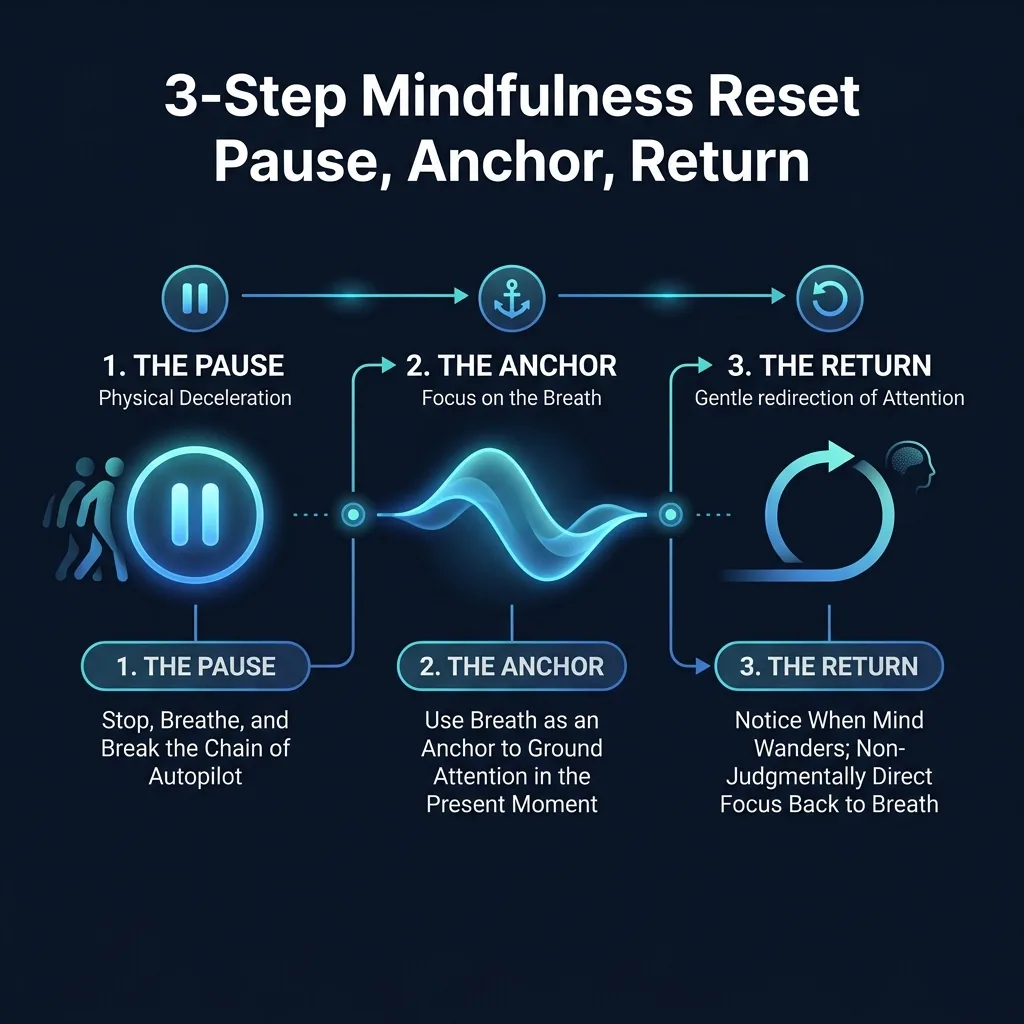
Figure 1: The 3-Step Mindfulness Reset cycle of pausing, anchoring focus, and returning attention.
The Pause
Stop what you are doing. Take your hands off the keyboard. Look away from the screen. Physically signal to your body that you are shifting gears.
The Anchor
Close your eyes and bring your full attention to the physical sensation of the breath passing the tip of your nose. Don't try to change the breath yet; just feel the cool air coming in and the warm air going out.
The Return
(The Critical Step) Within seconds, your mind will wander. You will think about emails or lunch. This is the moment of practice. Notice that you wandered. Do not criticise yourself. Simply smile internally at the wandering mind, and gently but firmly escort your attention back to the sensation at your nose.
We do not practice mindfulness to become better meditators; we practice it to become more human. By learning to step out of reactive habit, even for just a few breaths, we reclaim our agency. When we bring that active awareness to our breath, we stop simply going through the motions. We begin to feel the shifts as they happen, transitioning from mechanical breathing to true autonomic regulation. It is a slow, quiet training, but it is how we build a mind that is steady and a body that is at home.
Finding Your Anchor
The RE app is designed to support this exact process. Our guided tracks provide the auditory cues that act as "training wheels" for your attention, making it easier to stay anchored to the breath.
Try the three-step reset once today, on purpose, before you actually need it. Then see what is different the next time you do.
Download REScientific References & Further Reading
Important Note: This content is intended for informational and self-regulation purposes only. It is not a medical device and should not be used to replace professional medical advice, diagnosis, or treatment. Always seek the advice of your physician or other qualified health provider with any questions you may have regarding a medical condition.