Wired Differently: How Breathwork Calms the Neurodivergent Nervous System
Informational and self-regulation purposes only. Not a medical device.

At a Glance
- 01Coherent Breathing supports neurodivergent brains by quieting "cortical noise."
- 02Increases activity in the Parasympathetic Nervous System to reduce sensory overload.
- 03Improves "Interoception," the ability to sense and regulate internal body states.
- 04Regular practice builds a "vagal brake" to help navigate emotional intensity.
Getting diagnosed with AuDHD (Inattentive ADHD with a sprinkling of ASD) in my early 40s is a strange cocktail of emotions. First comes relief, the kind that makes you exhale a breath you did not know you had been holding for decades. Then, if you sit with it long enough, something quieter arrives: a grief for your younger self who never had this map. And then, eventually, the "aha." The retroactive understanding. Not what was wrong with me, but how I was wired. Oh, that is why I do things like I do.
Most wellness advice assumes a particular kind of brain. Quiet the mind. Sit with the discomfort. Just focus. For a lot of people, that instruction lands like a paradox. It is precisely what the brain will not do, and being told to do it anyway tends to pile frustration on top of an already full system. I know, because I spent most of my life bouncing off those instructions.
Out of necessity, I had to find my own hacks. I did not start using brown noise for sleep a decade ago because an expert recommended it; I did it because my brain was too loud to sleep in silence, and a deep, steady frequency was the only thing that could mask the internal chatter. Years later, when the AuDHD diagnosis came, it was not a surprise; it was confirmation. My nervous system had been reaching for a bottom-up tool all along.
Coherent Breathing approaches our brains in the exact same way. Instead of demanding that you quiet your mind first, it gives your body the physical rhythm first, letting the mind catch up.
The Neurodivergent Nervous System: A State of High Alert
Before my diagnosis, I often felt like my nervous system was a car idling with the RPMs pinned. For many neurodivergent individuals, the fight-or-flight sympathetic nervous system is easily triggered and slow to settle. This is not a lack of discipline; it is physiological, and it can manifest in several ways:
ADHD & The "Executive Gap"
ADHD is often characterised by what clinicians call the "executive gap": the frustrating distance between knowing what you need to do and being physically able to initiate the action. Physiologically, this gap is linked to lower Heart Rate Variability (HRV), which indicates a nervous system that struggles to pivot out of stress and mobilize for task initiation.
Autism & Sensory Processing
For those on the spectrum, the world can feel too loud. This sensory intensity often keeps the body in a state of high autonomic arousal, leading to quicker burnout and difficulty returning to a baseline calm.
How Coherent Breathing Helps
Coherent Breathing works by targeting the Vagus Nerve, the primary channel of the parasympathetic nervous system, and using rhythmic breath to send a direct, physical signal of safety to the brain. For the full mechanism behind why a specific pace matters, see Coherent Breathing 101; for more on why bottom-up regulation in particular suits ADHD and autistic brains, see ADHD, Burnout & the Somatic Anchor.
When we look at the science, we can see exactly why this bottom-up approach fits our physiology:
Quieting Cortical Noise: Neurodivergent brains often struggle with "cortical noise," which is an excess of background electrical activity that makes it hard to focus or settle. Paced, coherent breathing is proposed by researchers (such as in neurovisceral integration models) to promote cortical inhibition, acting like a physical dimmer switch to turn down the background volume in your head.
Tuning Interoception: Many of us face challenges with interoception (sensing what is happening inside the body, like hunger or a rising heart rate). Breathing in a predictable, timed rhythm provides a clear physical signal that helps the brain locate, track, and regulate internal states without getting overwhelmed.
Boosting Heart Rate Variability (HRV): A higher HRV gives your nervous system the flexibility it needs to pivot between tasks, handle stress, and self-soothe. For ADHD brains, manually raising HRV helps prevent that feeling of getting "stuck" in frustration or sensory overload.
Tailoring the Practice: A Sensory-Friendly Approach
RE takes a different approach: rather than asking you to create stillness before the tool is offered, it gives the brain something deliberate to hold. The body finds its way from there.
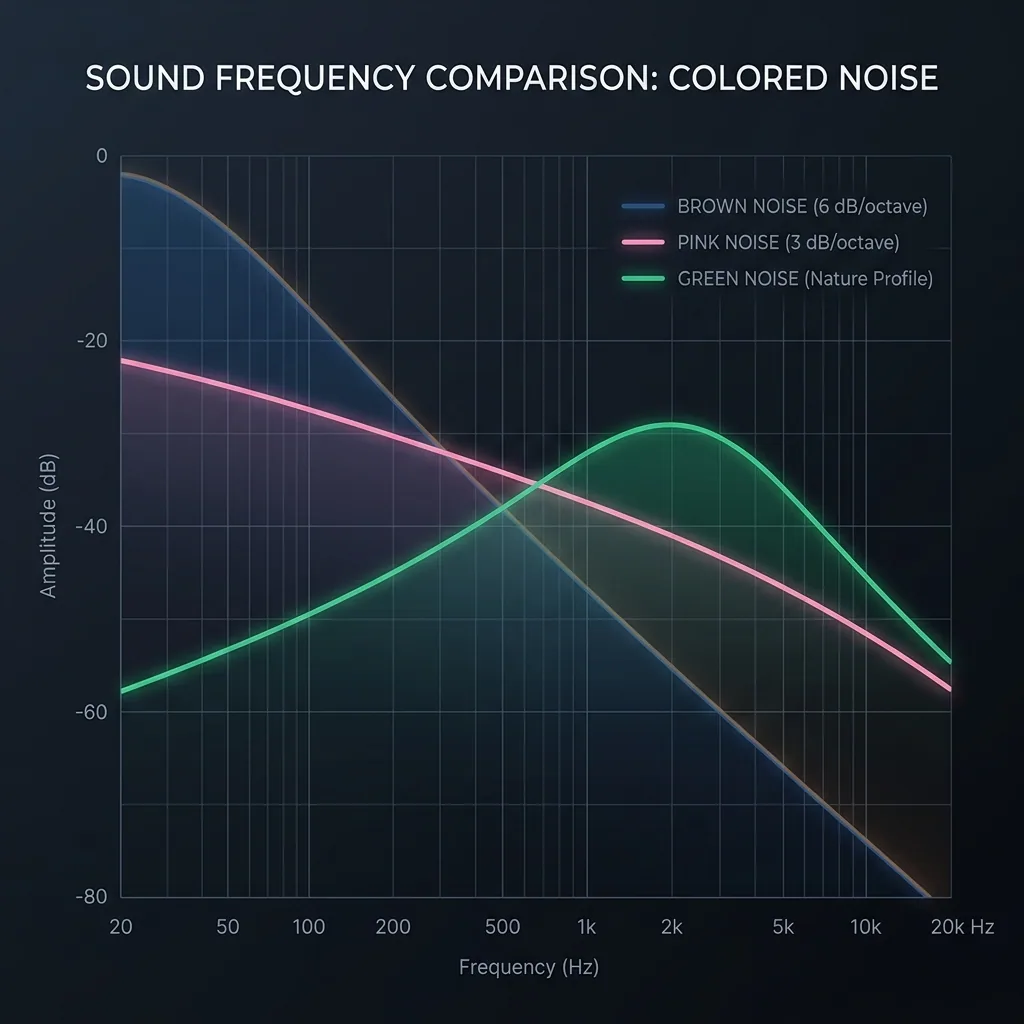
Figure 1: Visual comparison of Green, Pink, and Brown noise energy spectrums.
Sound as Anchor
The Sensory Studio offers Coloured Noise (Brown, Pink, or Green) and 5 Hz Theta Binaural Beats. For brains that find silence under-stimulating or overwhelming, a deliberate sound, like the nature-mimicking frequency of Green noise, keeps the mind engaged while the body quietens. It is not background noise. It is a signal.
Visual Guidance
The contracting and expanding visual guide gives your attention something external to follow. For brains that struggle with internal counting or instruction-following, the screen holds the rhythm for you. You just breathe.
The Micro-Dose
While 20 minutes is ideal for a full reset, even 2 to 5 minutes of coherence, whether before starting work, arriving home, or switching contexts, can significantly lower the day's cumulative stress load. You do not need a full session. You just need a moment.
The science behind this is solid and growing. Research consistently shows that neurodivergent nervous systems operate with lower HRV and respond strongly to a bottom-up approach: calm the body first, and the mind follows. It is not a workaround. It is the right direction of travel.
You Already Had the Map
Here is what I have come to believe, after a decade of brown noise and a few years of deliberate breathwork: the neurodivergent nervous system is not broken. It is sensitive. And sensitive systems, when they find the right input, respond profoundly.
What the diagnosis gave me was language. What Coherent Breathing gave me was a tool. Together, they changed the relationship I have with my own interior. Not by quieting me down. Not by making me less. But by giving my nervous system a rhythm it could finally follow, something steady underneath the noise.
You may have already been reaching for the right things without knowing why. The music you play to focus. The walks that reset you. The predictable routines that hold your day together. That was not weakness. That was your system asking for exactly what it needed.
This is just one more tool for that same shelf. It has a name now. It works from the body up. And for a sensitive nervous system, that turns out to be exactly where to start.
Built for Brains Like Ours
I built the Sensory Studio because I needed it. The breathwork, the brown noise, the visual anchors: they are not just features. They are the tools that helped me find stillness. I hope they do the same for you.
Enter the StudioScientific References & Further Reading
Important Note: This content is intended for informational and self-regulation purposes only. It is not a medical device and should not be used to replace professional medical advice, diagnosis, or treatment. Always seek the advice of your physician or other qualified health provider with any questions you may have regarding a medical condition.