The Brain That Changes: Using RE to Rewire From the Inside Out
Informational and self-regulation purposes only. Not a medical device.
At a Glance
- 01"Neurons that fire together, wire together." Consistency is key to neuroplasticity.
- 02The RE app builds a new "highway" for the nervous system to handle stress.
- 03Bottom-up regulation (breath) is often more effective than top-down (thought).
- 04Promotes grey matter density in the insula, enhancing interoceptive awareness.
For a long time, the assumption was that calm was a mental discipline. Control your thoughts. Manage your reactions. Choose differently. It's a reasonable model, and on a good day, it even works.
The problem is that when real stress hits, the rational mind is usually the last thing to show up.
What neuroscience now understands, and what the RE app, built on the practices of Mindfulness & Breathwork, is designed around, is that the brain is not a fixed machine. Through a process called neuroplasticity, it is constantly reorganising itself in response to repeated signals. And the fastest, most reliable signal you can send it doesn't come from your thoughts. It comes from your breath.
From experience
I first encountered this idea at a meditation retreat. At the end of one session, the teacher recommended a book: Norman Doidge's The Brain That Changes Itself.
The core idea is almost confrontationally simple: the brain is not fixed. At any age, we grow new neurons. Old patterns can be replaced with new ones. The anxious loops, the reactive defaults, the stress settings I'd spent years just managing. It turns out they were trainable. Neuroplasticity shifted from a clinical word I'd glossed over into something personal and actionable. It also reframed everything I was doing in my practice, not as stress management, but as genuine structural change. That understanding is woven into how I built the RE app: the brain changes through repetition, not through a single insight.
What is Neuroplasticity?
At its simplest, neuroplasticity is the brain's ability to change in response to experience. The neural pathways you use most frequently become stronger and faster (like a paved highway), while the ones you use less often begin to fade.
"Neurons that fire together, wire together." (Carla Shatz, summarizing Hebbian Theory, 1992)
If your daily life is defined by high stress, shallow breathing, and constant digital distraction, you are inadvertently "wiring" your brain for a high-arousal, reactive state. However, by intentionally practicing Mindfulness & Breathwork, you can begin to pave a new highway, one that leads to emotional stability, cognitive clarity, and a centred nervous system.
Rewiring from the Bottom Up
Most people think of "rewiring the brain" as a mental task (Top-Down). You try to think more positive thoughts or analyse your behaviour. While valuable, this can be incredibly difficult when your body is in a state of stress.
Mindfulness & Breathwork offer a "Bottom-Up" approach to neuroplasticity. When you breathe at a slow, resonant pace—specifically an inhale for 5.5 seconds and an exhale for 5.5 seconds, forming an 11-second cycle (about 5.5 breaths per minute)—you are sending a rhythmic, high-fidelity signal through the Vagus Nerve to the brain.
The 0.1 Hz Signal
Breathing at your resonant frequency (see Coherent Breathing 101 for the full mechanism) synchronises heart, lungs, and blood pressure into a unified wave. Research led by Mather and Thayer (2018) shows this resonance specifically targets the brain's beta-band activity, inhibiting the high-frequency noise of anxiety and allowing the brain to enter a more plastic, receptive state.
Strengthening the "Vagal Brake"
Every time you practice mindfulness and breathwork, you are exercising your Vagus Nerve. Much like a muscle, the more you use the Vagus Nerve to pivot from "fight or flight" into "rest and digest," the stronger that connection becomes. Over time, your brain becomes more efficient at returning to a state of calm after a stressful event. This is a hallmark of resilience.
Improving Interoceptive Accuracy
Neuroplasticity also applies to how you "feel" your body. A landmark study by Hölzel et al. (2011) shows that consistent mindfulness and breathwork practice increases the density of grey matter in the insula, the part of the brain responsible for interoception. This means you become more in tune with your body's signals, allowing you to catch stress before it turns into a full-blown reaction.
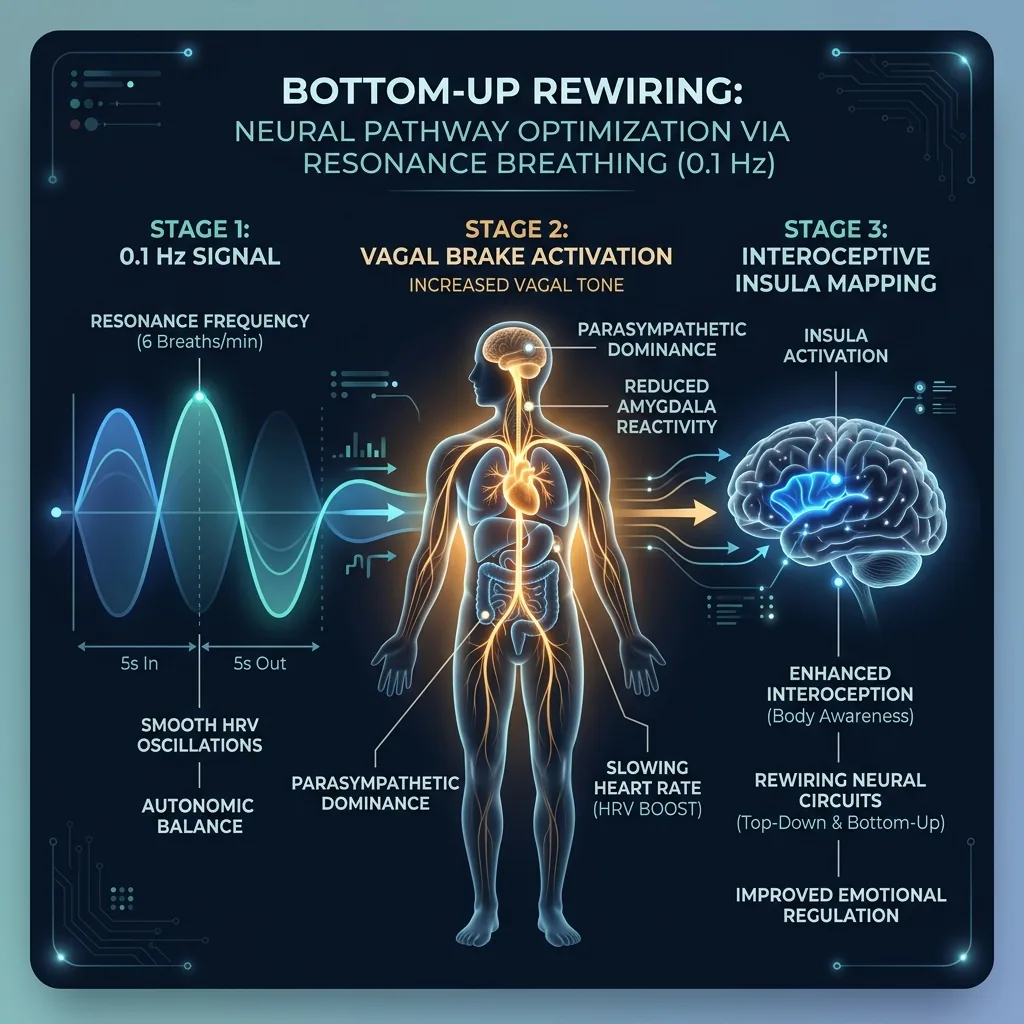
Figure 1: The three-stage Bottom-Up Rewiring process driven by mindfulness and breathwork.
The Therapeutic Dose: How to Make the Change Stick
Neural change doesn't happen overnight. It requires what researchers call a "Therapeutic Dose."
As the RE app explains, science suggests that practicing for 20 minutes a day is the tipping point. This duration is necessary to fully fatigue the stress response of the sympathetic nervous system and allow the new neural circuits to take hold.
When you sustain this rhythm for 20 minutes, you create a "carry-over effect." This means the neuroplastic changes you initiate during your session don't disappear when you open your eyes; they stay with you, maintaining your baseline of calm for hours.
Tips for Neural Transformation
- Consistency over IntensityIt is better to practice for 10 minutes every day than for 70 minutes once a week. Your brain needs repetitive signals to "wire" new pathways.
- Utilise Theta StatesThe RE app utilises 5Hz Theta Binaural Beats. Theta waves are associated with deep relaxation and enhanced neuroplasticity, acting as a "facilitator" for the changes you are making with your breath.
- Master the Continuous Loop (Sinusoidality)Focus on making the transition between your inhale and exhale completely seamless. By removing the pauses at the top and bottom of the breath, you create a smooth "sine wave" pattern in your heart rate. This stable, rhythmic signal is the most effective way to communicate safety and order to the brain's neuroplastic centres.
Reclaim Your Brain
You are not stuck with the nervous system you have today. Whether you are navigating the complexities of ADHD, recovering from chronic stress, or simply seeking peak performance, the tools for change are literally within your chest.
By practicing mindfulness and breathwork, you are giving your brain the signal it needs to evolve.
Download REScientific References & Further Reading
Important Note: This content is intended for informational and self-regulation purposes only. It is not a medical device and should not be used to replace professional medical advice, diagnosis, or treatment. Always seek the advice of your physician or other qualified health provider with any questions you may have regarding a medical condition.