Sama Vritti: The Ancient Blueprint for RE
Informational and self-regulation purposes only. Not a medical device.

At a Glance
- 01Sama Vritti means "Equal Fluctuation," the ancient name for mind quietening through balanced breath.
- 02Long inhale, long exhale. The body was designed for this rhythm: it is a homecoming, not a technique.
- 03Buddhist, Christian, and Sufi traditions all independently arrived at the same rhythmic breath for inner quiet.
- 04By making the inhale and exhale equal, counting fades away, and breathing becomes a doorway to presence.
I wasn't trying to do anything special. I was just breathing, in long, out long. But somewhere in the middle of that simple act, something let go. The body softened without being told to and my awareness expanded without me seeking it out.
It happened during a mindfulness of breathing session: a quiet room and an instruction I had heard a dozen times but never really felt: breathe in long, breathe out long. What struck me wasn't the technique. It was what happened beneath it. The longer I held that rhythm, the more the mental noise fell away. Not suppressed, just no longer fed. And into that quiet, something else arrived. A kind of open, clear awareness that felt more like remembering than discovering.
That moment made me understand why the yogis had built entire traditions around the breath. They had found that same doorway. They just happened to find it thousands of years before the rest of us.
The Ancient Mirror: Breath and Mind
The Sanskrit word Sama means "equal" or "balanced." Vritti means "fluctuation," the movements or ripples of the mind. Put them together and you get a phrase that describes both a breathing pattern and a state of consciousness at the same time: equal fluctuation.
The ancient yogis understood that the mind and the breath are not separate systems. They mirror each other constantly. When your breath is short, erratic, and shallow, your thoughts tend to follow. When your breath becomes long, even, and unhurried, the mental landscape shifts. The yogis called mental turbulence chitta vritti, the incessant ripples of thought that cloud the surface of awareness. Sama Vritti was their answer: not to silence the mind by force, but to smooth the water from the inside.
"Yoga is the stilling of the fluctuations of the mind." - Patanjali, Yoga Sutras, ~200 CE
Patanjali, writing over two thousand years ago, wasn't describing a relaxation exercise. He was describing a direct path to clarity of consciousness. Breath was the vehicle. Not because breathing is magical, but because it is the one bridge between the voluntary and the involuntary self. It is the only automatic function you can also consciously choose to change. That makes it uniquely powerful.
A Lineage Older Than Science
What moves me about Sama Vritti is not just its effectiveness. It's its age. This practice didn't emerge from a clinical trial or a biohacker's podcast. It was discovered by human beings sitting quietly with their own experience, paying close attention to what happened when they breathed slowly and evenly for long periods of time.
And they weren't alone. Across traditions and continents, from Buddhist mindfulness of breathing (Anapanasati), Christian contemplative prayer, and Sufi breath practices, the same pattern keeps appearing. Long, rhythmic, equal breath as a threshold into a quieter, more open state of being. The names differ. The robes differ. The doorway is the same.
There's something quietly profound in that convergence. When independent human traditions arrive at the same answer across thousands of years and miles, it's worth paying attention to.
The Long Breath & The Open Awareness
Here is what I've come to understand: when you breathe for a long breath of mindfulness or 5.5 seconds in breathwork, you are not forcing relaxation. You are removing the obstruction to it. The body already knows how to be at rest. The long breath is simply a signal, a message sent directly to the survival brain that says: there is no threat here. It is safe to let go.
And when the survival brain steps back, something else steps forward. Awareness, quiet, open, and clear, fills the space that anxious thinking had been occupying. This isn't a spiritual concept. It's what you actually notice when you sit still long enough. The thoughts don't stop, but they lose their urgency. The body softens. And you realize that stillness was there the whole time, underneath the noise you were making.
What It Actually Feels Like
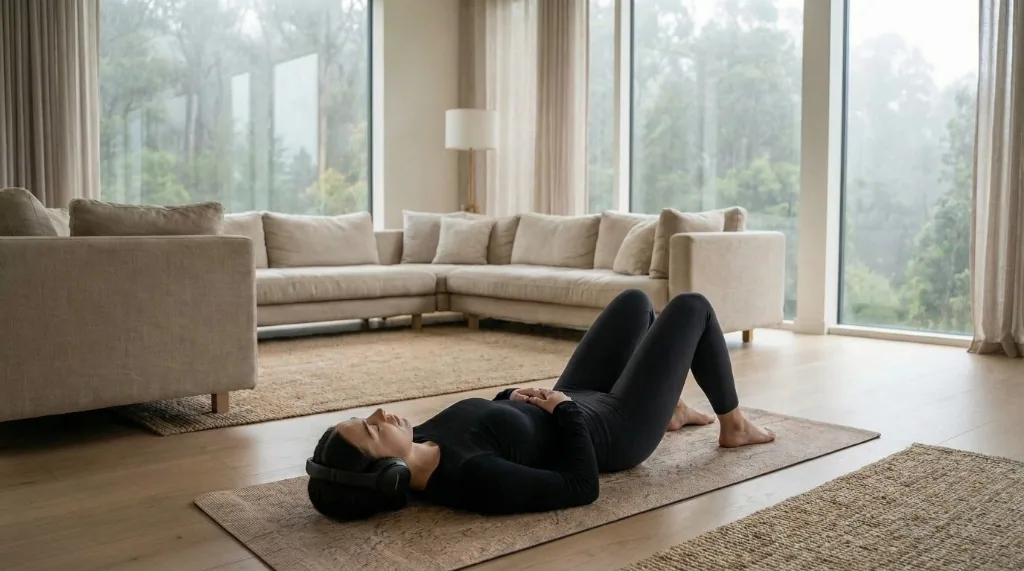
There is a moment, usually somewhere in your second or third minute of practice, when the breath finds itself. The counting quietens. The effort dissolves. The inhale meets the exhale without a seam, and something deep in the body recognises this as home.
It does not feel dramatic. There is no flash of light. It feels more like removing a noise you had stopped noticing. Only in the silence do you realize how loud it had been. The shoulders drop a little. The jaw softens. The field of awareness seems to widen, as though your attention had been looking through a keyhole and the whole door has swung open.
Where Ancient Meets Modern
The one challenge with traditional Sama Vritti is the counting. There's a certain irony to it. You're using the analytical mind to quiet the analytical mind. The moment you're calculating "one, two, three, four," you're still thinking your way through it.
What the science confirms, quietly and without ceremony, is that the ancient yogis arrived at the same place modern researchers eventually did. A 5.5-second breath (equal in, equal out) produces an oscillation of approximately 0.1 Hz in the body's cardiovascular system, the same rhythm covered in full in Coherent Breathing 101.
The ancients did not have the instruments to measure it. They had something better: thousands of hours of careful attention to their own experience.
This is where the RE App was built to help. By providing a gentle audio and visual guide to pace your breath, RE lets you step out of the counting and into the feeling. You surrender the rhythm to the sound, and the sound holds it for you. The ancient practice remains entirely intact: you simply stop having to manage it consciously.
Let the Breath Find You
Experience the ancient stillness of Sama Vritti, guided by sound, held by rhythm, without the effort of counting. Just breathe long. The rest takes care of itself.
Start BreathingScientific References & Further Reading
Important Note: This content is intended for informational and self-regulation purposes only. It is not a medical device and should not be used to replace professional medical advice, diagnosis, or treatment. Always seek the advice of your physician or other qualified health provider with any questions you may have regarding a medical condition.