Sleep As Recovery: The Overnight Nervous System Reset
Informational and self-regulation purposes only. Not a medical device.
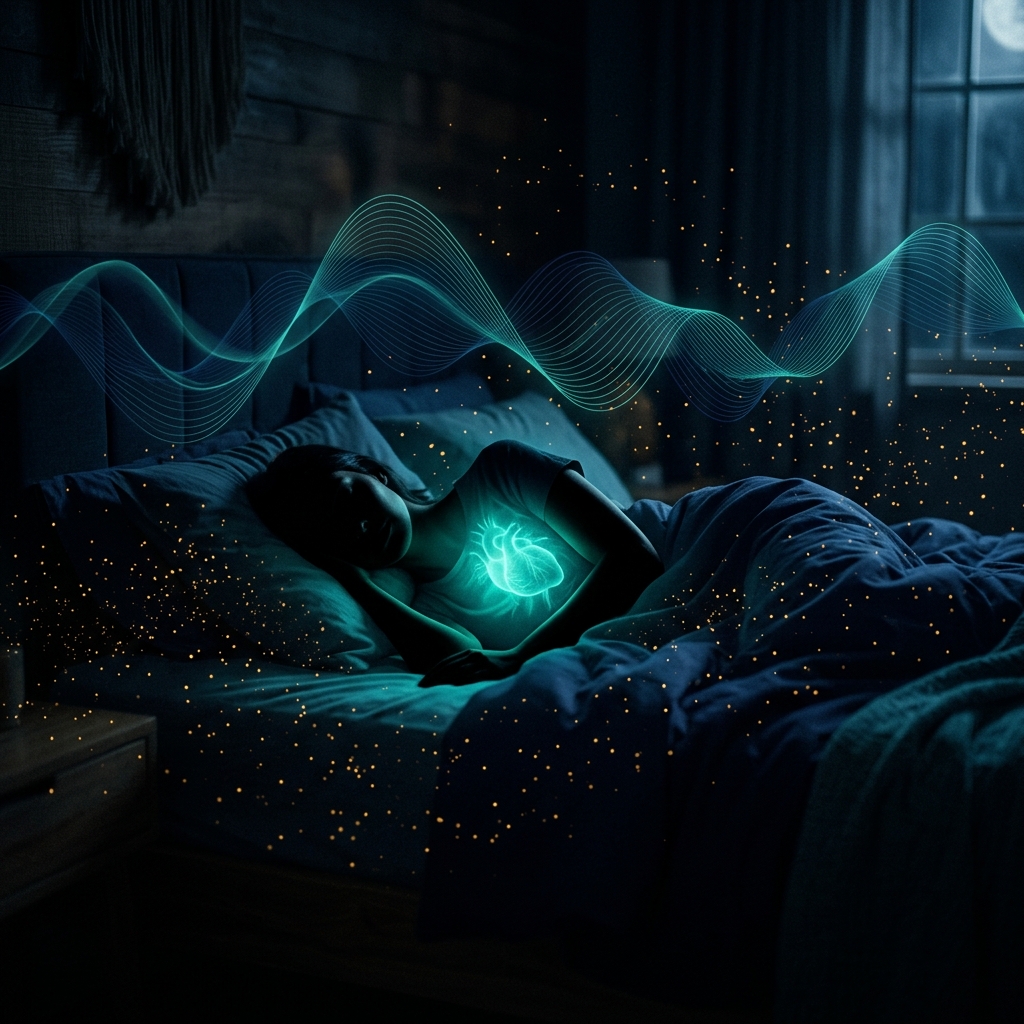
At a Glance
- 01Overnight HRV during deep slow-wave sleep is the true marker of autonomic restoration.
- 02Chronic stress carries elevated cortisol into the night, suppressing deep sleep even when physically exhausted.
- 03Brown noise raises a steady acoustic floor so ambient sounds stop pulling the brain out of deep sleep cycles.
- 04Twenty minutes of coherent breathing before bed lowers the autonomic starting point for deeper restorative sleep.
There is a version of sleep that restores you, and a version that simply passes time. From the outside, they look identical: eight hours horizontal, eyes closed, breathing slow. But what happens internally is not the same thing at all.
The nervous system does not switch off at midnight. It keeps running, and whether it runs in recovery mode or defensive mode depends almost entirely on the state you brought to bed. Go to bed with a sympathetic nervous system still running at high frequency, and your body will spend the night processing threat signals rather than doing the tissue repair, memory consolidation, and autonomic restoration that sleep is actually for.
Sleep is not passive rest. It is an active biological state with its own architecture, and that architecture only delivers its full benefit when the right conditions are in place going in.
What Sleep Actually Does — Neurologically
Sleep runs in cycles of roughly 90 minutes, each moving through progressively deeper non-REM stages (NREM1, NREM2, NREM3) before cycling back up into REM. The stage that matters most for physical and autonomic recovery is NREM3, also called slow-wave sleep: the phase characterised by high-amplitude, low-frequency delta waves in the brain.
During slow-wave sleep, the brain runs a biological cleaning process called the glymphatic system, flushing metabolic waste that accumulated during the day. Growth hormone release is concentrated in this phase. The immune system does much of its overnight surveillance here. And for nervous system health specifically, the autonomic system shifts into clear parasympathetic dominance: heart rate drops, vagal tone rises, and the baroreflex settles into a long, slow oscillation. That rhythm is what genuine rest looks like from the inside.
"During NREM sleep, particularly slow-wave sleep, there is a pronounced shift toward parasympathetic dominance, with heart rate variability significantly elevated compared to wakefulness and REM sleep."
— Burgess et al. (1997), Journal of Applied Physiology
Heart rate variability, specifically RMSSD (the beat-to-beat variation measured in milliseconds), tracks this autonomic state closely. High RMSSD during slow-wave sleep means the parasympathetic system was genuinely dominant through the night. Suppressed RMSSD, in someone who slept eight hours, means the nervous system never fully downregulated. That single number carries more information about your recovery quality than the time on the clock.
The Sympathetic Hangover
Most people who feel underslept do not have a sleep quantity problem. They have a sleep quality problem, and the root of it is physiological: they are arriving at bed in the wrong state.
Chronic stress, even the low-grade kind that never spikes into obvious crisis, keeps cortisol elevated well into the evening. Cortisol is arousing by design. It suppresses melatonin, maintains cardiovascular readiness, and keeps the brain's alerting systems partially online in ways that are directly incompatible with slow-wave sleep. The body may feel tired. The nervous system is not standing down.
Call it a sympathetic hangover. The body is exhausted but the threat-detection machinery is still running. Sleep onset stretches out. NREM3 stays shallow and short. The night cycles repeatedly through Stage 1 and Stage 2, light sleep that is easily disrupted, without ever descending far enough to complete meaningful autonomic work.
People who experience burnout, and neurodivergent individuals managing chronic sensory overload, show measurably lower nocturnal HRV and less slow-wave sleep than their peers, regardless of hours in bed. Spending more time asleep does not fix a nervous system that never properly downregulated.
From experience
For a long time I measured sleep by hours. Seven felt adequate, eight felt good, anything under six was a problem worth worrying about. I tracked duration on my watch and figured that if the number looked reasonable, I was probably recovering.
The shift came when I started looking at HRV alongside sleep data. There were nights where I slept 7.5 hours and woke up genuinely restored: RMSSD high, morning HRV solid, mind clear from the first minute. Then there were nights, more than I expected, where I had slept the same duration and the numbers told an entirely different story. Low HRV. Suppressed slow-wave time. Morning brain fog that no amount of coffee moved.
The difference almost always traced back to what I had done in the two hours before bed. Evenings that ended with work, screens, and unresolved mental load produced the poor nights. Evenings with 20 minutes of coherent breathing, even gentle and informal, produced measurably better recovery. The RE App did not tell me what to believe. The data did.
What Brown Noise Actually Does to Your Sleep

Brown noise: nature's original sleep companion.
Brown noise sits heavier in the bass frequencies and rolls off gradually into the higher registers. White noise, by comparison, distributes equal energy across the full spectrum and can feel thin or harsh. Brown noise sounds more like rain on a rooftop, or a river heard from the next room: present without being intrusive.
Its main job during sleep is acoustic masking. Bedrooms are rarely silent, and the auditory cortex does not fully disengage during sleep. A door closing, a car outside, a partner shifting in bed: each creates a brief spike in acoustic energy that can trigger a micro-arousal. The person does not wake consciously, but the brain pulls toward lighter sleep. Across a full night, those small disruptions accumulate and eat into slow-wave time.
Brown noise addresses this by raising a consistent acoustic floor. The brain has a steady signal to settle against, rather than a shifting environment to keep monitoring. Cortical reactivity decreases, micro-arousals occur less often, and sleep onset (the time from drowsy to genuinely asleep) tends to shorten.
There is also research connecting coloured noise to stochastic resonance: the somewhat counterintuitive finding that a small, well-calibrated amount of background noise can improve signal detection in neural systems by helping weak signals cross activation thresholds. Applied to sleep, this suggests brown noise may do more than just mask disruptions. It may support the kind of low-amplitude synchronised oscillations that characterise deep sleep directly.
HRV — The Overnight Report Card
Your morning HRV score is not a measure of how you feel today. It is a record of what your nervous system did last night.
Nocturnal RMSSD, measured across the deep sleep phases, tracks how far the parasympathetic system was actually dominant through the night. A high reading means the vagal brake was genuinely engaged and the body completed real autonomic work. A suppressed reading means shallow cycling, sympathetic intrusion, and a night that passed without full restoration, regardless of hours on the clock.
Athletes and anyone paying close attention to recovery track HRV on waking for this reason. The evening reading tells you your starting state. The morning reading tells you what the night delivered. Over time, consistent evening breathwork produces a visible pattern: lower pre-sleep arousal corresponds to higher overnight HRV and more time spent in slow-wave sleep.
The Evening Wind-Down Protocol
This is not a prescription; it is a framework. The nervous system responds to patterns more than to any individual night. What you are building is a consistent pre-sleep signal that the body learns to recognise as the beginning of descent.
60 minutes before bed: screen dimming and environment shift
Blue-spectrum light suppresses melatonin and keeps the brain's alerting systems running. Dimming screens, switching to warmer light sources, and making some physical change to the space (closing a door, putting away work) signals the hypothalamus to begin the hormonal shift toward sleep. This step requires no effort. It just needs to be consistent.
40 minutes before bed: brown noise, low volume
Open the RE App and start a brown noise session at a volume that is audible but not demanding, roughly equivalent to distant rain. The goal is a stable acoustic baseline the auditory cortex can settle into, not something loud enough to mask your thoughts. If your setup allows, let it run through the wind-down and into sleep.
20 minutes before bed: coherent breathing session
Twenty minutes of resonant frequency breathing (see Coherent Breathing 101 for the mechanism and how to find your own pace) is the physiological centrepiece of this routine. Lehrer and Gevirtz (2014) found that HRV biofeedback at resonant frequency produces measurable vagal tone increases that persist well past the session itself. That carry-over effect is the state you are bringing to sleep.
At the threshold of sleep: release the technique
Most evening breathwork guides skip this part. When you feel the physical signs of sleep onset (limb heaviness, narrowing attention, thoughts becoming less sequential), stop counting the breath. Let it find its own rhythm. The nervous system has the signal it needs; consciously pacing the breath at the edge of sleep can actually slow onset by keeping a degree of cortical engagement running. The session is done. Let it go.
The protocol works because it targets the actual mechanism. It lowers sympathetic arousal before the body needs to enter slow-wave sleep, rather than hoping the body can manage that transition on its own. Nothing here is sedating. What it does is create the conditions under which the body's own sleep architecture can work the way it was built to.
Compare your morning HRV after a night with the full wind-down against a night without it. The number will tell you more about what happened while you slept than the hours on the clock ever could.
Start Tonight
Your morning HRV is a record of what your nervous system did last night. The RE App gives you the tools to change that record, starting tonight, before you close your eyes.
Brown noise, coherent breathing, and haptic pacing in a single session, built to bring your autonomic system to the threshold of genuine recovery and then step aside so sleep can do its work.
Download REScientific References & Further Reading
Important Note: This content is intended for informational and self-regulation purposes only. It is not a medical device and should not be used to replace professional medical advice, diagnosis, or treatment. Always seek the advice of your physician or other qualified health provider with any questions you may have regarding a medical condition.